0 goods.
The authenticity of a diamond, like any other precious stone, must be documented. Thus, the buyer will receive proof that he is buying an original jewel, and in case of resale, he will be able to ask for a fair price, based on the characteristics of the stone in the passport.
The global standard for evaluating diamond quality is the “4C” system and the International Diamond Grading System™, developed by the Gemological Institute of America (GIA).
In this article, we will analyze what the GIA certificate is, why the organization that issues it is trusted all over the world, what parameters are specified in it, and how to check the authenticity of the certificate.
What is a GIA certificate?
A GIA certificate is a passport that confirms the qualitative and quantitative characteristics of a gemstone, as well as its origin. Such certificates are issued for natural diamonds, pearls and colored gemstones. For artificial diamonds, the certificate can only be issued electronically.
The GIA Institute was founded in 1931 and today is the most authoritative organization in the field of gemology. Its employees are engaged in the study of the origin of precious stones, systematization of knowledge, training of specialists, evaluation of processing quality and development of industry standards.
The accuracy of the results of precious stone research is ensured by innovative equipment and the supervision of experienced scientists.
To guarantee the objectivity of research results, the data of the client who ordered the analysis is classified. The GIA organization is independent of any commercial organizations, private individuals or political groups.
GIA certificates are considered the standard for evaluating the quality of precious stones. Buyers around the world are driven by their data.
What parameters are indicated in the GIA passport for a diamond
There are several types of GIA certificates depending on the type of stone. Let’s consider the main sections of the certificate using the example of a sample issued for a natural round diamond with a standard cut.
General view of the GIA Certificate
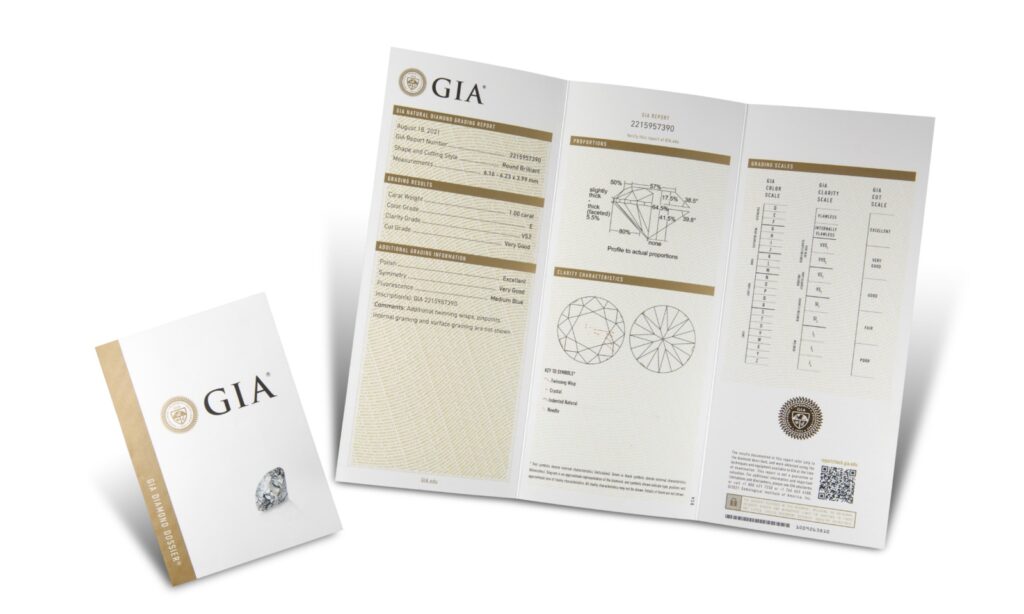
GIA certificate for a standard cut natural round diamond
The first block of information
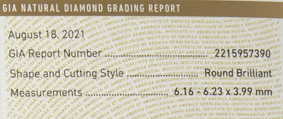
The first block of information in a GIA certificate
The date of issue and the unique serial number of the certificate are indicated here. Using this number, you can check the authenticity of the document on the official GIA.EDU website.
Next, the shape and cut style of the diamond is indicated. In this case, it is “Round Diamond”.
The bottom line of this block shows the geometric dimensions of the diamond: diameter and depth (height). Measurements are made by the 3D scanning method and are given with an accuracy of hundredths of a millimeter. Two values are given for the diameter, which are indicated by a dash. These are the minimum and maximum values obtained during measurements.
The second block
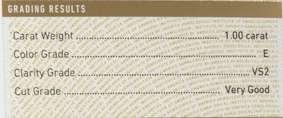
Block of information with the main parameters of the diamond
There are 4 lines in this block:
1. The weight of the diamond in carats to the nearest hundredth.
2. Diamond color. It is indicated by a symbol from the diamond color grading scale developed by the GIA institute. It describes the color of a diamond according to its saturation: from D – colorless, to Z – light yellow or brown. The color scale itself is given on the third page of the certificate.
3. The purity of a diamond. It characterizes the number, size, shape, origin and location of various inclusions and defects inside and outside the stone.
The purity of a diamond is also evaluated on a special scale containing 11 values: from flawless (Flawless) to undesirable (Included, I3). This scale is also given on the third page of the certificate.
For diamonds weighing more than 1 carat, the purity characteristics are shown in the chart on the center page of the certificate. The nature of the inclusions is described in detail below the diagram.
In the event that the color or clarity of the diamond has been improved by an artificial method, an asterisk (*) is placed next to their values. Methods for improving the quality of the diamond are indicated in the comments section at the bottom of the page.
4. Cutting For standard round diamonds, the GIA has developed a cut grading scale that includes 5 values:
– perfectly;
– very well;
– good;
– satisfactorily;
– badly.
When evaluating the quality of cutting, scientists examine 7 properties of a stone: polishing, symmetry, weight ratio, strength, brightness, play of light, shine.
The third block
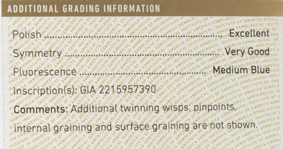
Block of information with additional parameters of the diamond
This block provides additional information about the diamond:
1. Polishing quality.
2. Symmetry.
3. Ability to fluorescence – glow under the influence of ultraviolet radiation.
In some cases, this column may describe the characteristics of extraneous inclusions that affect the clarity of the diamond.
The following is the text of the marking inscription, which is made by a laser beam on the roundness – the dividing line of the diamond, which divides it into a crown (upper part) and a pavilion (lower cone-shaped part).
Below are comments on methods of artificial diamond enhancement, etc.
The second page of the certificate
The top line shows the identification number of the certificate, which can be used to check its authenticity.
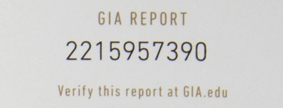
The GIA certificate identification number shown on its center page
Below is a graphic representation of a diamond showing the exact proportions of its parts.
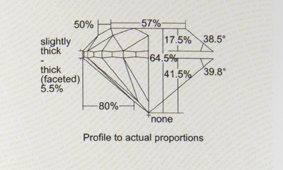
Graphic representation of a diamond with exact proportions
Exact geometric ratios in a diamond are especially important to know when making exclusive jewelry to order. For example, when you need to choose diamonds of identical size for two identical earrings.
On the same page, a conventional image of a diamond (if it is more than 1 carat) is given, with the designation of various extraneous inclusions and defects that affect the degree of purity of the diamond.
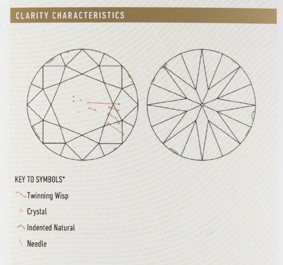
Conventional image of a diamond with the designation of all extraneous inclusions and defects in its structure
At the very bottom of the page are explanations of the color codes used below the schematic image.
The third page of the certificate
Here are the color, clarity, and cut quality grading scales used by GIA experts when analyzing a gemstone.
Scales for evaluating diamond quality parameters developed by the GIA Institute
Below them is the logo of the GIA laboratory:

GIA laboratory logo
It is applied in a special way, which makes counterfeiting impossible.
Below the logo there is an explanation of the certificate and a QR code, which can be used to check the authenticity of the document.
The certificate notes the following: “The results documented in this certificate are for the described diamond only and were obtained using techniques and equipment available to GIA at the time of examination. This certificate is not a warranty card or evaluation documentation. For more information, including important limitations and disclaimers, please visit GIA.edu/terms or call: +1 800 421 7250 or +1 760 603 4500.”
At the bottom of this page is a block of information about how this certificate is protected against forgery:
The text reads: “The security features of this document are provided by hologram, shielding, and microprinting in addition to those methods not listed above that exceed industry standards for document security.”
The main elements of a GIA certificate are described above. The content of the passport may differ, depending on the type of precious stone for which it is issued.
A GIA certificate is the first thing to ask for when you want to verify the authenticity of a diamond, find out its country of origin and all the key parameters that determine its value.
Callback
Send us your phone number and we will call you back
By clicking the Order button, I agree to the processing of personal data
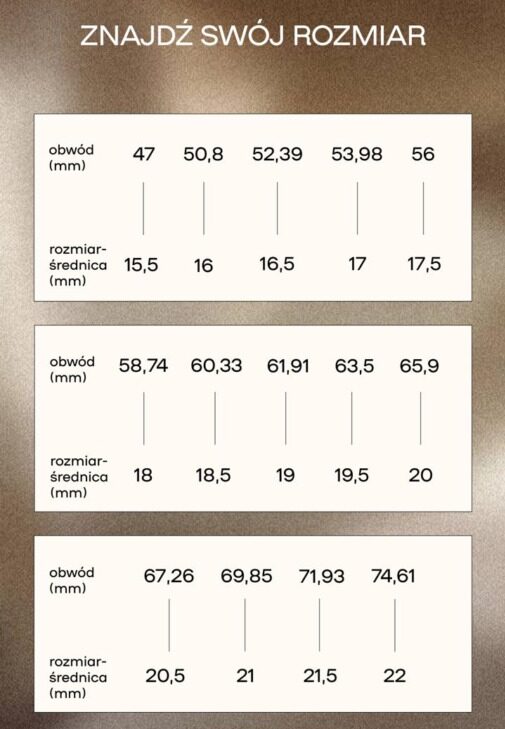
Send us the size you need
The product has been added to the cart
DZIĘKUJEMY ZA ZAKUP!
Twoje zamówienie zostało przyjęte do realizacji. List potwierdzający został wysłany na podany adres e-mail.


